Medical translation services
Certified translations by medical subject-matter experts
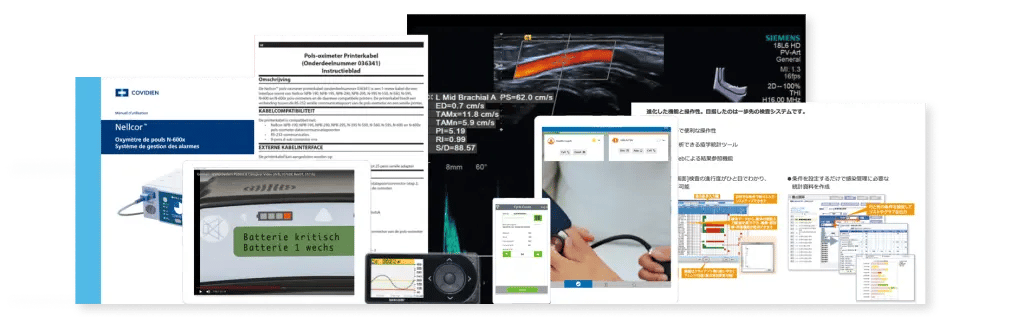
Clinical research, technical manuals, instructions for use, regulatory documentation, and medical software applications contain highly technical terminology and must follow ethical and legal regulations.
SimulTrans’ subject-matter experts leverage a defined process to accurately translate life science content for use by patients and clinicians.
All of our translations are backed by an ISO-certified quality management system, which enables us to meet the rigorous standards of the medical industry. When requested, translations can be back-translated to verify they are 100% accurate.
Our medical localization services include:
- Medical document translation
- Clinical trial translation
- Regulatory compliance translation
- Diagnostic software localization
- Medical device manual translation
- Instructions for use translation
How it works
- 1.To begin the translation process, upload your files, receive a free quote, and approve it.
Pro tip: for ongoing translation needs, connectors to your file repository make the content transfer process even easier. - 2.SimulTrans’ expert linguists translate your content into your requested languages on your schedule.
- 3.SimulTrans’ reviewers check all content for terminology accuracy and linguistic style.
- 4.SimulTrans formats your content in its original source format.
- 5.If requested, SimulTrans conducts back translation to ensure accuracy and provides signed certificates of translation.
- 6.You receive your translated content.
- 7.When you need updates or have more content to translate, SimulTrans uses translation memory to ensure you don’t pay to translate the same text twice.
Your long-term medical localization partner
SimulTrans is the preferred translation partner of so many leading life science companies because of our deep understanding of the industry’s unique needs, including global regulatory processes.
Our experienced project managers are always ready to jump on a call and find the best solution for your needs. This flexible, hands-on attitude is why we’ve been able to achieve a 97% customer satisfaction rate in 2025 and remain a leader in the industry since 1984.

![]() |
Benefits of partnering with SimulTrans:
- There’s never an added cost to you for the tools and technology we use to translate your materials.
- We’ll always suggest the most cost-effective solution for your needs.
- Translation memory saves time and money by reducing unnecessary rework while maintaining consistency.
- The SimulTracker portal keeps every project organized and improves collaboration between teams.
- We connect our systems to yours to automate ongoing translation projects, accelerating work and reducing admin needs.
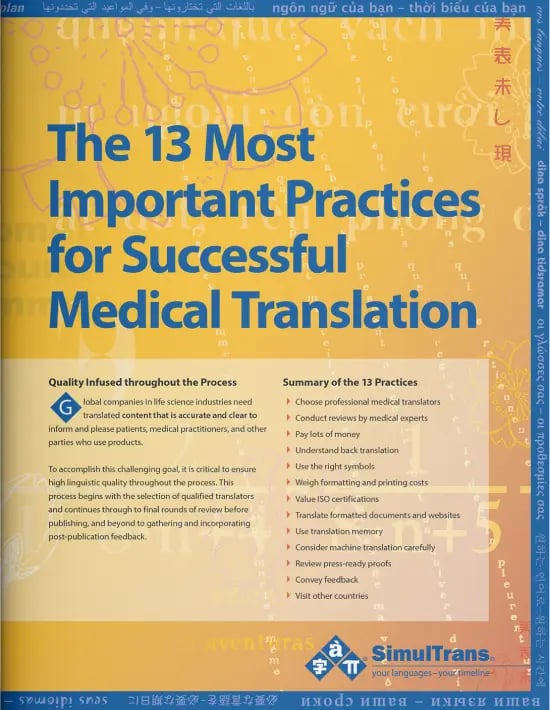
13 Best Practices for Successful Medical Translation
More insights

Medical Translation Services: Frequently Asked Questions
IFU Translation: Requirements and Best Practices
Life Sciences Case Study
Frequently asked questions
What is translation certification?
Many pharmaceutical, medical device, and contract research organization clients need certificates of translation to comply with specific process requirements (or simply for extra peace of mind).
SimulTrans provides signed certificates (in electronic format) that verify translations are true, accurate, complete, correct, and performed to the best of the translators’ ability and expertise.
What qualifications do your medical translators have?
SimulTrans works only with professional linguists who are native speakers of the target language and have at least five years of specialized experience. Many of our translators hold degrees in medicine or clinical research and are fluent in industry-specific terminology.
How much does medical translation cost?
Costs vary by language, typically corresponding to the cost of living in the target countries (for example, translation into Simplified Chinese is about a third of the cost of translation into Swedish). SimulTrans provides discounts based on repeated text by leveraging translation memory. Document formatting costs are typically calculated on a per-page basis.
Use this cost calculator to get an estimate based on an average language cost.
How long does medical translation take?
Medical translation projects can take between three days and three months, depending on word count and team size. Each translator usually translates about 2,000 words per day, and our translators work simultaneously so the number of target languages won’t impact your timeline.
We can accommodate almost any timeline by scaling your translation team. A typical team has three translators and two reviewers per language, while some projects have over 100 translators per language!
What is back translation and when is it required for medical and clinical documents?
Back translation is the process of translating a previously translated document back into the original source language, independently and without reference to the source text. It serves as a critical quality assurance step in medical, clinical, and regulatory translation workflows.
Back translations are required or strongly recommended in several contexts:
- Clinical trials: institutional review boards (IRBs) and ethics committees frequently require back translation of informed consent forms, patient questionnaires, and study protocols to verify accuracy
- Regulatory submissions: certain health authorities require back translation as evidence of translation fidelity for labeling and IFU documentation
- Instrument validation: back translation is a standard step in adapting clinical outcome assessments (COAs), patient-reported outcomes (PROs), and psychometric instruments for new language markets
At SimulTrans, back translations are always completed by linguists who had no involvement in the original translation and no access to the source material. Because language nuance and structure differ across languages, a back translation will never be word-for-word identical to the original, and that is by design. Meaningful divergences are flagged, reviewed, and resolved, helping to identify missing content, mistranslations, or ambiguities before submission.
Which file formats and regulatory document types do you support for medical translation?
SimulTrans works with any file format used in medical, regulatory, and technical documentation, including Excel, Word, JSON, HTML, XML, DITA, InDesign, and Figma, with no reformatting burden on your team.
We manage the full translation workflow, including back translation and multilingual formatting, for the complete range of regulated medical documents:
- FDA submissions: 510(k) premarket notifications and Premarket Approval (PMA) applications
- Device documentation: Device Master Records (DMR) and Design History Files (DHF)
- Risk management: Risk Management Files under ISO 14971
- Labeling and IFUs: Instructions for Use and device labeling under 21 CFR Part 801
- Regulatory compliance: translation certificates issued for all deliverables
Can you translate medical device documents for EU MDR compliance?
Yes. SimulTrans specializes in medical device translation and helps companies to be fully compliant with EU MDR 2017/745.
We accurately translate all manufacturer information that must accompany your device, including documents, labeling, and Instructions for Use (IFUs) into over 100 languages. We offer forward and back translations and certificates of translation.
Do you provide certified translation services for in vitro diagnostic devices (IVDs)?
Yes. SimulTrans is an ISO-certified provider of medical translation. We deliver all types of translations (and back translations) for in vitro diagnostic medical devices (IVDs) using qualified linguists.
Our certified translations help companies meet EU MDR, IVDR, and FDA requirements and support the safety, quality, and regulatory compliance of their medical devices.
Which ISO certifications does SimulTrans hold for translation and post-editing?
Yes. SimulTrans has three separate certifications.
-
ISO 9001 certification. It ensures we have a well-documented process, follow it consistently, and strive to continuously improve.
-
ISO 17100 certification. It aims to standardize terminology, define basic requirements for services, and create a framework for interaction between customers and service providers.
-
ISO 18587 certification. It details requirements for human post-editing of machine translation.
Are you ISO-certified for medical translation and FDA labeling compliance?
Yes. SimulTrans is certified to three ISO standards and follows a rigorous quality management system. Our ISO‑driven processes and certified translations help medical companies meet regulatory requirements such as FDA 21 CFR Part 801 for medical device labeling, including the rule that any foreign‑language content on a label must be accompanied by a complete English translation, and vice versa.
Which life sciences organizations do you serve?
SimulTrans serves organizations across the life sciences sector where translation accuracy, traceability, and regulatory compliance are non-negotiable:
- Medical device manufacturers requiring IFU, labeling, and technical documentation translation for global market entry
- Pharmaceutical and biotech companies needing clinical trial documentation, patient-facing materials, and drug labeling in multiple languages
- Contract research organizations (CROs) managing multilingual regulatory submissions and study documentation across jurisdictions
- In vitro diagnostic (IVD) manufacturers meeting EU IVDR and FDA requirements for diagnostic device documentation
What our clients share is a common standard: translations that are accurate, traceable, and built to withstand scrutiny from international health authorities, including the FDA, EMA, and notified bodies.
Do you provide translation services that comply with Section 1557 of the Affordable Care Act?
Yes. SimulTrans provides certified translation services that support compliance with Section 1557 of the Affordable Care Act (ACA), which requires meaningful access to healthcare for individuals with limited English proficiency (LEP).
We deliver accurate, human-reviewed translations of patient-facing documents, including consent forms, discharge instructions, and notices of rights, into over 100 languages, ensuring your organization meets the clear and accurate communication standards the law requires.
Do you localize Software as a Medical Device (SaMD) and Software in a Medical Device (SiMD)?
Yes. SimulTrans localizes both Software as a Medical Device (SaMD) and Software in a Medical Device (SiMD) for global regulatory submissions and market entry.
Our medical software localization services cover the full workflow, terminology extraction, user interface translation, UI and controls adaptation, reformatting, and rigorous testing, combining automated language quality assessment (LQA) with human testers, ensuring your software meets the accuracy and usability standards required by FDA, EU MDR, and IVDR.