Document translation services
We translate over 1 million words per day.
SimulTrans works with some of the world’s leading brands, translating technical manuals, marketing materials, and all other types of business documents.
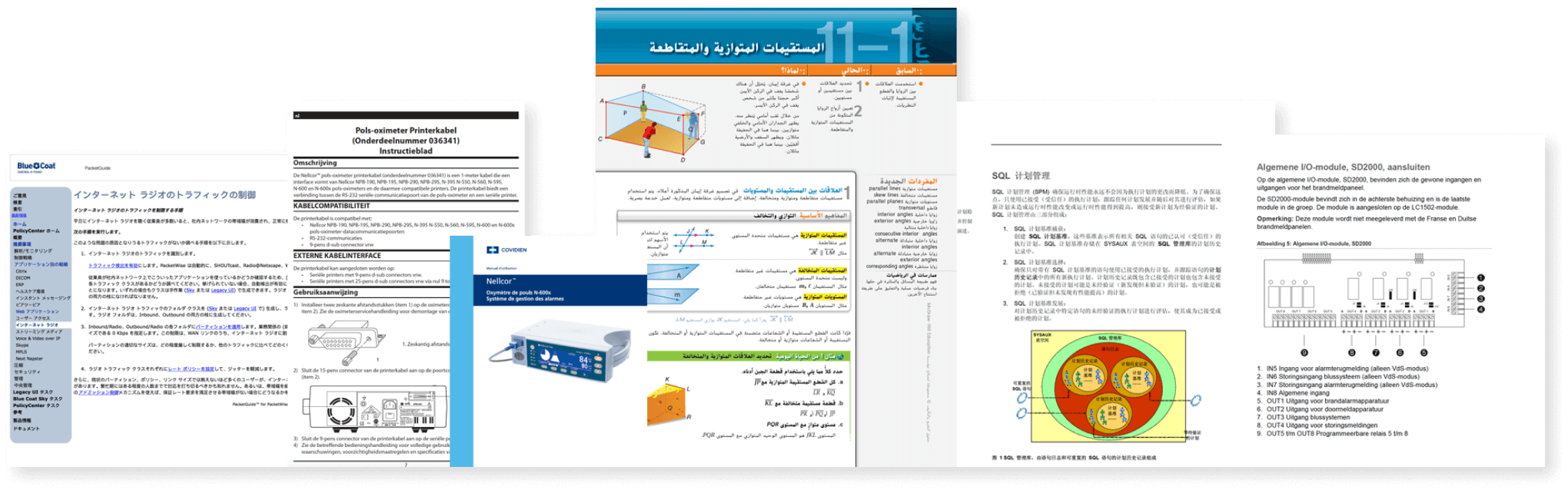
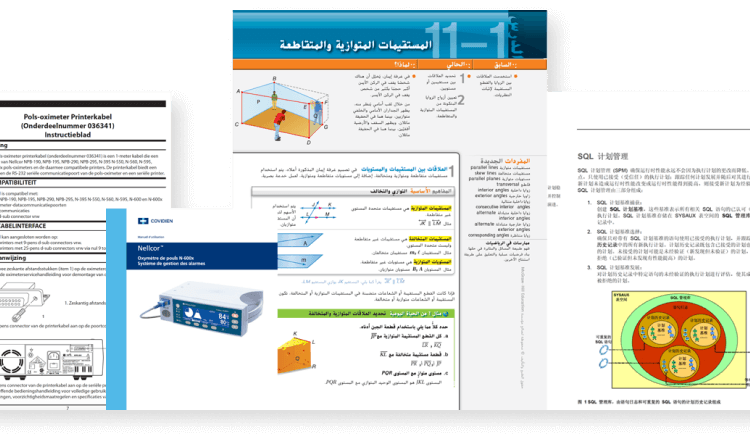
Document translation isn’t just about using the right words. Our multilingual publishing specialists will also ensure translated documents match their original layouts.
How it works
- 1.To begin the translation process, upload your files, receive a free quote, and approve it.
Pro tip: for ongoing translation needs, connectors to your file repository make the content transfer process even easier. - 2.SimulTrans’ expert linguists translate your content into your requested languages on your schedule.
- 3.SimulTrans’ reviewers check each document for terminology accuracy and linguistic style.
- 4.SimulTrans formats your documents in their original source formats.
- 5.You receive your translated documents.
- 6.When you need updates or have more documents to translate, SimulTrans uses translation memory to ensure you don’t pay to translate the same text twice.
Your long-term localization partner
SimulTrans is the preferred translation partner of so many leading brands because we’re able to meet all localization needs as businesses grow and change.
Our experienced teams are always available to work with you to find the best solution for your needs. This flexible, hands-on attitude is why we’ve been able to achieve a 97% customer satisfaction rate in 2025 and remain a leader in the industry since 1984.
|
|
Benefits of partnering with SimulTrans:
- There’s never an added cost to you for the tools and technology we use to translate your materials.
- We’ll always suggest the most cost-effective solution for your needs.
- Translation memory saves time and money by reducing unnecessary rework while maintaining consistency.
- The SimulTracker portal keeps every project organized and improves collaboration between teams.
- We connect our systems to yours to automate ongoing translation projects, accelerating work and reducing admin needs.
Writing for a Global Audience.
More insights
Capturing International Growth in the $1 Trillion Semiconductor Industry
How to Adapt Your Marketing Message for the French Market
Should Your Employee Handbook Be Translated?
Frequently asked questions
How much does document translation cost?
Costs vary by language, typically corresponding to the cost of living in the target countries (for example, translation into Simplified Chinese is about a third of the cost of translation into Swedish). SimulTrans provides discounts based on repeated text by leveraging translation memory. Document formatting costs are typically calculated on a per-page basis.
Use this cost calculator to get an estimate based on an average language cost.
How long does document translation take?
Document translation projects can take between three days and three months, depending on word count and team size. Each translator usually translates about 2,000 words per day, and our translators work simultaneously so the number of target languages won’t impact your timeline.
We can accommodate almost any timeline by scaling your translation team. A typical team has three translators and two reviewers per language, while some projects have over 100 translators per language!
What file formats do you support for technical document translation?
SimulTrans works with dozens of source file formats including Word (.docx), PDF, InDesign, FrameMaker, XML, HTML, DITA, Markdown, and more. You never need to copy-paste content or reformat files before submitting. We preserve original layouts and styles in the translated output, so your documents are ready to publish without additional desktop publishing work.
How do you ensure translation consistency across large or ongoing documentation projects?
We use translation memory (TM) technology to store every previously approved translation. When the same or similar content appears again, such as in updated product manuals or revised regulatory submissions, TM automatically applies the approved translation. This guarantees terminology consistency across all documents in a program and eliminates redundant work.
We also develop a project-specific glossary at the start, so every linguist can access it and apply the same terminology throughout your content.
Do your translators have subject-matter expertise in technical fields?
All SimulTrans translators are full-time professional linguists with verified subject-matter expertise, not generalists, freelance platforms, or students. For technical documentation, we assign translators with domain-specific backgrounds in areas such as industrial machinery, factory automation, equipment, etc.
What quality assurance process applies to translated technical documents?
Every document translation project at SimulTrans follows a structured QA workflow: expert translation, independent review by a subject-matter linguist for accuracy and style, and a final formatting check to ensure the translated output matches the original document layout. For high-stakes content, additional review tiers are applied.
What industries do you specialize in?
SimulTrans works with many different industries, such as Apparel, Chemicals, Education and Training, Electronics and Semiconductors, Energy, Food and Beverages, Machinery and Industrial Equipment, Medical, Pharmaceuticals and Biotechnology, Technology, Telecommunications, and Transport, to mention a few. If your industry isn't listed, contact us; our linguist network spans virtually every technical domain.
What types of technical content do you translate?
SimulTrans translates the full spectrum of technical documentation that businesses need to operate, sell, and comply in global markets. Our most frequently translated content types include: user manuals, operator guides, and installation documentation; API documentation, engineering specifications, datasheets, and bills of materials (BOMs); safety data sheets (SDS/MSDS) and hazardous materials documentation; standard operating procedures (SOPs), employee handbooks, safety instructions, and compliance materials.